Technopedia Center
PMB University Brochure
Faculty of Engineering and Computer Science
S1 Informatics S1 Information Systems S1 Information Technology S1 Computer Engineering S1 Electrical Engineering S1 Civil Engineering

faculty of Economics and Business
S1 Management S1 Accountancy

Faculty of Letters and Educational Sciences
S1 English literature S1 English language education S1 Mathematics education S1 Sports Education
  • Registerasi
  • Brosur UTI
  • Kip Scholarship Information
  • Performance
  1. Weltenzyklopädie
  2. Onde de Stokes
Onde de Stokes 👆 Click Here! Read More..
Un article de Wikipédia, l'encyclopédie libre.
Ondes de Stokes quasi-planes créées dans le sillage d'un navire..

Les ondes de Stokes sont des ondes de gravité rencontrées sur la surface de la mer, des vagues. Elles ont des solutions des équations d'Euler pour un fluide incompressible irrotationnel à surface libre soumis à un champ de gravité qui ont été obtenues par George Gabriel Stokes par la théorie des perturbations en 1847[1],[2] dans le cas d'un milieu de profondeur infinie.

Ondes de gravité

[modifier | modifier le code]

Équations d'Euler pour un fluide incompressible irrotationnel soumis à un champ de gravité

[modifier | modifier le code]

Pour un écoulement incompressible irrotationnel la vitesse dérive d'un potentiel ψ, les équations d'incompressibilité et de quantité de mouvement s'écrivent

[ 1 ] ∇ 2 ψ = 0 {\displaystyle [1]\quad \nabla ^{2}\psi =0} {\displaystyle [1]\quad \nabla ^{2}\psi =0}
[ 2 ] ρ ∂ ψ ∂ t + 1 2 ρ ( ∇ ψ ) 2 + p + ρ g z = 0 {\displaystyle [2]\quad \rho {\frac {\partial \psi }{\partial t}}+{\frac {1}{2}}\rho \,(\nabla \psi )^{2}+p+\rho gz=0} {\displaystyle [2]\quad \rho {\frac {\partial \psi }{\partial t}}+{\frac {1}{2}}\rho \,(\nabla \psi )^{2}+p+\rho gz=0}

où ρ est la masse volumique, p la pression, g la gravité et z l'altitude.

Démonstration

On montre[3] que pour un écoulement incompressible irrotationnel la vitesse dérive d'un potentiel ψ

V = ∇ ψ {\displaystyle \mathbf {V} =\nabla \psi } {\displaystyle \mathbf {V} =\nabla \psi }

En reportant dans l'équation d'incompressibilité   ∇ ⋅ V = 0 {\displaystyle \textstyle \mathbf {\nabla } \cdot \mathbf {V} =0} {\displaystyle \textstyle \mathbf {\nabla } \cdot \mathbf {V} =0}  on voit que ψ obéit à l'équation de Laplace

∇ 2 ψ = 0 {\displaystyle \nabla ^{2}\psi =0} {\displaystyle \nabla ^{2}\psi =0}

L'équation de quantité de mouvement s'écrit alors

ρ ∂ V ∂ t + ρ ∇ V V + ∇ p − ρ g = 0 {\displaystyle \rho {\frac {\partial \mathbf {V} }{\partial t}}+\rho \nabla V\,\mathbf {V} +\mathbf {\nabla } p-\rho \,\mathbf {g} =0} {\displaystyle \rho {\frac {\partial \mathbf {V} }{\partial t}}+\rho \nabla V\,\mathbf {V} +\mathbf {\nabla } p-\rho \,\mathbf {g} =0}

Par ailleurs la gravité g dérive d'un potentiel

g = − ∇ ϕ {\displaystyle \mathbf {g} =-\nabla \phi } {\displaystyle \mathbf {g} =-\nabla \phi }

À l'échelle du problème on peut considérer g constant et écrire

ϕ = ϕ 0 + g z {\displaystyle \phi =\phi _{0}+gz} {\displaystyle \phi =\phi _{0}+gz}

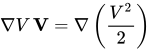
En remarquant que   ∇ V V = ∇ ( V 2 2 ) {\displaystyle \nabla V\,\mathbf {V} =\nabla \left({\frac {V^{2}}{2}}\right)} {\displaystyle \nabla V\,\mathbf {V} =\nabla \left({\frac {V^{2}}{2}}\right)}  on obtient

∇ ( ρ ∂ ψ ∂ t + 1 2 ρ V 2 + p + ρ ϕ ) = 0 {\displaystyle \nabla \left(\rho {\frac {\partial \psi }{\partial t}}+{\frac {1}{2}}\rho V^{2}+p+\rho \phi \right)=0} {\displaystyle \nabla \left(\rho {\frac {\partial \psi }{\partial t}}+{\frac {1}{2}}\rho V^{2}+p+\rho \phi \right)=0}

Soit, en intégrant la constante d'intégration dans ϕ0

ρ ∂ ψ ∂ t + 1 2 ρ ( ∇ ψ ) 2 + p + ρ g z = 0 {\displaystyle \rho {\frac {\partial \psi }{\partial t}}+{\frac {1}{2}}\rho \,(\nabla \psi )^{2}+p+\rho gz=0} {\displaystyle \rho {\frac {\partial \psi }{\partial t}}+{\frac {1}{2}}\rho \,(\nabla \psi )^{2}+p+\rho gz=0}

Milieu à surface libre

[modifier | modifier le code]

Dans le cadre d'un problème bidimensionnel, on désigne par s(x) l'altitude de la surface par rapport à sa valeur au repos z = 0.

L'équation ci-dessus s'écrit à la surface

[ 2 ] ρ ∂ ψ ∂ t + 1 2 ρ ( ∇ ψ ) 2 + ρ g s = − p 0 e n z = s {\displaystyle [2]\quad \rho {\frac {\partial \psi }{\partial t}}+{\frac {1}{2}}\rho \,(\nabla \psi )^{2}+\rho gs=-p_{0}\quad \mathrm {en} \;z=s} {\displaystyle [2]\quad \rho {\frac {\partial \psi }{\partial t}}+{\frac {1}{2}}\rho \,(\nabla \psi )^{2}+\rho gs=-p_{0}\quad \mathrm {en} \;z=s}

où p0 est la pression atmosphérique.

Cette surface est décrite par l'équation cinématique

∂ s ∂ t + V x ∂ s ∂ x = V z ⇒ [ 3 ] ∂ s ∂ t = ∂ ψ ∂ z − ∂ ψ ∂ x ∂ s ∂ x {\displaystyle {\frac {\partial s}{\partial t}}+V_{x}{\frac {\partial s}{\partial x}}=V_{z}\quad \Rightarrow [3]\quad \quad {\frac {\partial s}{\partial t}}={\frac {\partial \psi }{\partial z}}-{\frac {\partial \psi }{\partial x}}{\frac {\partial s}{\partial x}}} {\displaystyle {\frac {\partial s}{\partial t}}+V_{x}{\frac {\partial s}{\partial x}}=V_{z}\quad \Rightarrow [3]\quad \quad {\frac {\partial s}{\partial t}}={\frac {\partial \psi }{\partial z}}-{\frac {\partial \psi }{\partial x}}{\frac {\partial s}{\partial x}}}

Par ailleurs la condition cinématique au fond z = - h(x) s'écrira

V z + V x ∂ h ∂ x = ∂ ψ ∂ z + ∂ ψ ∂ x ∂ h ∂ x = 0 {\displaystyle V_{z}+V_{x}{\frac {\partial h}{\partial x}}={\frac {\partial \psi }{\partial z}}+{\frac {\partial \psi }{\partial x}}{\frac {\partial h}{\partial x}}=0} {\displaystyle V_{z}+V_{x}{\frac {\partial h}{\partial x}}={\frac {\partial \psi }{\partial z}}+{\frac {\partial \psi }{\partial x}}{\frac {\partial h}{\partial x}}=0}

Dans le cas particulier d'un fond plat utilisé par la suite on a

[ 4 ] ∂ ψ ∂ z = 0. {\displaystyle [4]\quad {\frac {\partial \psi }{\partial z}}=0.} {\displaystyle [4]\quad {\frac {\partial \psi }{\partial z}}=0.}

Solutions périodiques

[modifier | modifier le code]
Ondes de Stokes d'ordre 1 (sinusoïdale) et 2 en milieu peu profond.

On cherche une solution au système constitué par les équations [1], [2], [3], [4] sous forme d'ondes périodiques progressives

s = s ( θ ) , ψ = ψ ( z , θ ) , θ = k x − ω t = k ( x − c t ) {\displaystyle s=s(\theta )\,,\quad \psi =\psi (z,\theta )\,,\quad \theta =kx-\omega t=k(x-ct)} {\displaystyle s=s(\theta )\,,\quad \psi =\psi (z,\theta )\,,\quad \theta =kx-\omega t=k(x-ct)}

où θ est la phase de l'onde, k le nombre d'onde et c la vitesse de phase.

Pour s, on utilise un développement en série de Fourier autour de la solution de repos (s = 0)

s = a cos ⁡ ( θ ) + μ 2 a 2 cos ⁡ ( 2 θ ) + . . . {\displaystyle s=a\cos(\theta )+\mu _{2}a^{2}\cos(2\theta )+...} {\displaystyle s=a\cos(\theta )+\mu _{2}a^{2}\cos(2\theta )+...}

où a est l'amplitude.

Il lui correspond le développement suivant pour ψ[4], suggéré par la solution du problème linéarisé[5]

ψ = ν 0 a 2 t + ν 1 a sin ⁡ θ + ν 2 a 2 sin ⁡ 2 θ cosh ⁡ ( 2 k ( z + h 0 ) + . . . ) {\displaystyle \psi =\nu _{0}\,a^{2}t+\nu _{1}\,a\sin {\theta }+\nu _{2}\,a^{2}\sin {2\theta }\cosh(2k(z+h_{0})+...)} {\displaystyle \psi =\nu _{0}\,a^{2}t+\nu _{1}\,a\sin {\theta }+\nu _{2}\,a^{2}\sin {2\theta }\cosh(2k(z+h_{0})+...)}

Pour ω, on choisit une forme paire de l'amplitude compatible avec la périodicité en s (ψ n'est pas nécessairement périodique)

ω = ω 0 ( k ) + a 2 ω 2 ( k ) + . . . {\displaystyle \omega =\omega _{0}(k)+a^{2}\omega _{2}(k)+...} {\displaystyle \omega =\omega _{0}(k)+a^{2}\omega _{2}(k)+...}

La solution du système limité au second ordre conduit aux résultats suivants[4]

  • relation de dispersion
ω 2 g k τ = 1 + ( 9 τ 4 − 10 τ 2 + 9 8 τ 4 ) k 2 a 2 + . . . , τ = tanh ⁡ k h 0 {\displaystyle {\frac {\omega ^{2}}{gk\tau }}=1+\left({\frac {9\tau ^{4}-10\tau ^{2}+9}{8\tau ^{4}}}\right)k^{2}a^{2}+...\,,\qquad \tau =\tanh {kh_{0}}} {\displaystyle {\frac {\omega ^{2}}{gk\tau }}=1+\left({\frac {9\tau ^{4}-10\tau ^{2}+9}{8\tau ^{4}}}\right)k^{2}a^{2}+...\,,\qquad \tau =\tanh {kh_{0}}}
  • coefficients du développement pour s
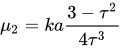
μ 2 = k a 3 − τ 2 4 τ 3 {\displaystyle \mu _{2}=ka{\frac {3-\tau ^{2}}{4\tau ^{3}}}} {\displaystyle \mu _{2}=ka{\frac {3-\tau ^{2}}{4\tau ^{3}}}}
μ2 est le rapport des amplitudes des deux premières composantes de l'onde.
  • coefficients du développement pour ψ
ν 0 = g k 2 sinh ⁡ ( k h 0 ) , ν 1 = ω 0 k sinh ⁡ ( k h 0 ) , ν 2 = 3 ω 0 sinh 4 ⁡ ( k h 0 ) {\displaystyle \nu _{0}={\frac {gk}{2\sinh(kh_{0})}}\,,\qquad \nu _{1}={\frac {\omega _{0}}{k\sinh(kh_{0})}}\,,\qquad \nu _{2}={\frac {3\omega _{0}}{\sinh ^{4}(kh_{0})}}} {\displaystyle \nu _{0}={\frac {gk}{2\sinh(kh_{0})}}\,,\qquad \nu _{1}={\frac {\omega _{0}}{k\sinh(kh_{0})}}\,,\qquad \nu _{2}={\frac {3\omega _{0}}{\sinh ^{4}(kh_{0})}}}
  • Vitesse de phase
c = g τ k {\displaystyle c={\frac {g\tau }{k}}} {\displaystyle c={\frac {g\tau }{k}}}

Propriétés des solutions

[modifier | modifier le code]

On a en particulier

  • en eau profonde (k h0 → ∞
k h 0 → ∞ , ω 2 ≃ g k [ 1 + ( k a ) 2 ] , μ 2 ≃ 1 2 k a {\displaystyle kh_{0}\rightarrow \infty \,,\quad \omega ^{2}\simeq gk[1+(ka)^{2}]\,,\qquad \qquad \quad \mu _{2}\simeq {\frac {1}{2}}ka} {\displaystyle kh_{0}\rightarrow \infty \,,\quad \omega ^{2}\simeq gk[1+(ka)^{2}]\,,\qquad \qquad \quad \mu _{2}\simeq {\frac {1}{2}}ka}
L'approche est valide pour des hauteurs de vague de faible amplitude devant la longueur d'onde
μ 2 << 1 ⇒ a << λ {\displaystyle \mu _{2}<<1\quad \Rightarrow \quad a<<\lambda } {\displaystyle \mu _{2}<<1\quad \Rightarrow \quad a<<\lambda }
où λ = 2π/k la longueur d'onde.
  • en eau peu profonde k h0 → 0
k h 0 → 0 , ω 2 ≃ g h 0 k 2 [ 1 + 9 ( k a ) 2 8 ( k h ) 4 ] , μ 2 ≃ 3 32 π 2 U , U = H λ 2 h 0 3 {\displaystyle kh_{0}\rightarrow 0\,,\;\;\quad \omega ^{2}\simeq gh_{0}k^{2}\left[1+{\frac {9(ka)^{2}}{8(kh)^{4}}}\right]\,,\qquad \mu _{2}\simeq {\frac {3}{32\pi ^{2}}}\,{\mathcal {U}}\,,\quad {\mathcal {U}}={\frac {H\lambda ^{2}}{h_{0}^{3}}}} {\displaystyle kh_{0}\rightarrow 0\,,\;\;\quad \omega ^{2}\simeq gh_{0}k^{2}\left[1+{\frac {9(ka)^{2}}{8(kh)^{4}}}\right]\,,\qquad \mu _{2}\simeq {\frac {3}{32\pi ^{2}}}\,{\mathcal {U}}\,,\quad {\mathcal {U}}={\frac {H\lambda ^{2}}{h_{0}^{3}}}}
où U le nombre d'Ursell.
Pour une eau peu profonde l'approche est utilisable lorsque

μ 2 << 1 ⇒ U << 32 π 2 3 ≃ 100 {\displaystyle \mu _{2}<<1\quad \Rightarrow \quad {\mathcal {U}}<<{\frac {32\pi ^{2}}{3}}\simeq 100} {\displaystyle \mu _{2}<<1\quad \Rightarrow \quad {\mathcal {U}}<<{\frac {32\pi ^{2}}{3}}\simeq 100}

Autres propriétés

[modifier | modifier le code]
  • Il existe des solutions pour un développement jusqu'à l'ordre 5[6].
  • L'approche peut être utilisée pour des ondes stationnaires[7] ou aléatoires[8],[9].
  • Tullio Levi-Civita a démontré la convergence des développements utilisés pour des ondes de faible amplitude et un milieu de profondeur infinie[10]. Ce résultat a été étendu aux milieux à profondeur finie par Dirk Jan Struik[11].
  • Thomas Brooke Benjamin et Jim E. Feir on montré l'instabilité de la solution pour les fortes profondeurs[12]. L'instabilité de Benjamin-Feir peut conduire à la formation d'une vague scélérate[13].

Références

[modifier | modifier le code]
  1. ↑ (en) G. G. Stokes, « On the Theory of Oscillatory Waves », Transactions of the Cambridge Philosophical Society, vol. 8,‎ 1847, p. 441–455 (lire en ligne)
  2. ↑ (en) G. G. Stokes, « Supplement to a paper on the theory of oscillatory waves », Cambridge University Press,‎ 1880, p. 314-326 (lire en ligne)
  3. ↑ (en) Lev Davidovitch Landau et Evgueni Mikhaïlovitch Lifshitz, Volume 6 of Course of Theoretical Physics : Fluid Mechanics, Pergamon Press, 1987 [1]
  4. ↑ a et b (en) Gerald B. Whitham, Linear and Nonlinear Waves, John Wiley & Sons, 1974 (ISBN 978-0-4713-5942-5, lire en ligne)
  5. ↑ Michel Talon, « Ondes de surface », sur LPTHE Université Paris VI, 2006
  6. ↑ (en) S. C. De, « Contributions to the Theory of Stokes Waves », Mathematical Proceedings of the Cambridge Philosophical Society, vol. 51, no 4,‎ 1955, p. 713–736
  7. ↑ (en) M. A. Grant, « Standing Stokes Waves of Maximum Height », Journal of Fluid Mechanics, vol. 60, no 3,‎ 1973, p. 593–604
  8. ↑ (en) Michel K. Ochi, « Hurricane-Generated Seas », Elsevier,‎ 2003, p. 119 (ISBN 9780080443126)
  9. ↑ (en) M. A. Tayfun, « Narrow-band Nonlinear Sea Waves », Journal of Geophysical Research, vol. 85, no C3,‎ 1980, p. 1548–1552
  10. ↑ Tullio Levi-Civita, « Détermination rigoureuse des ondes permanentes d'ampleur finie », Mathematische Annalen, vol. 93,‎ 1925, p. 264–314 (lire en ligne)
  11. ↑ Dirk Jan Struik, « Détermination rigoureuse des ondes irrotationelles périodiques dans un canal à profondeur finie », Mathematische Annalen, vol. 95, no 1,‎ 1926, p. 595–634 (lire en ligne)
  12. ↑ (en) Thomas Brooke Benjamin et Jim E. Feir, « The Disintegration of Wave Trains on Deep Water. Part 1. Theory », Journal of Fluid Mechanics, vol. 27, no 3,‎ 1967, p. 417-430 (lire en ligne)
  13. ↑ (en) Kristian Dysthe, Harald E. Krogstad et Peter Müller, « Oceanic Rogue Waves », Annual Review of Fluid Mechanics, vol. 40,‎ 2008, p. 287-310
  • (en) Graham W. Griffiths et William E. Schiesser, « Linear and Nonlinear Waves », sur Scholarpedia
  • (en) Cet article est partiellement ou en totalité issu de l’article de Wikipédia en anglais intitulé « Stokes wave » (voir la liste des auteurs).

Voir aussi

[modifier | modifier le code]
  • Onde cnoïdale
  • Équations de Boussinesq
  • Équations de Barré de Saint-Venant
  • Équation de Korteweg-de Vries
  • Équation de Whitham
  • Tsunami
  • icône décorative Portail de la physique
  • icône décorative Portail du monde maritime
Ce document provient de « https://fr.wikipedia.org/w/index.php?title=Onde_de_Stokes&oldid=198602808 ».
Catégories :
  • Onde de gravité
  • Océanographie
Catégories cachées :
  • Portail:Physique/Articles liés
  • Portail:Sciences/Articles liés
  • Portail:Maritime/Articles liés

  • indonesia
  • Polski
  • الرية
  • Deutsch
  • English
  • Español
  • Français
  • Italiano
  • مصر
  • Nederlands
  • 本語
  • Português
  • Sinugboanong Binisaya
  • Svenska
  • Українска
  • Tiếng Việt
  • Winaray
  • 中文
  • Русски
Sunting pranala
Pusat Layanan

UNIVERSITAS TEKNOKRAT INDONESIA | ASEAN's Best Private University
Jl. ZA. Pagar Alam No.9 -11, Labuhan Ratu, Kec. Kedaton, Kota Bandar Lampung, Lampung 35132
Phone: (0721) 702022
Email: pmb@teknokrat.ac.id