Un article de Wikipédia, l'encyclopédie libre.
Le calcul d'une primitive fonction est l'une des deux opérations de base de l'analyse et comme cette opération est délicate à effectuer, à l'inverse de la dérivation , des tables de primitives connues sont souvent utiles.
Nous savons qu'une fonction continue sur un intervalle admet une infinité de primitives et que ces primitives diffèrent d'une constante ; nous désignons par C constante arbitraire qui peut seulement être déterminée si nous connaissons la valeur de la primitive en un point.
∫
f
(
x
)
d
x
{\displaystyle \int f(x)\,\mathrm {d} x}
intégrale indéfinie de f f
Linéarité :
∫
(
a
f
(
x
)
+
b
g
(
x
)
)
d
x
=
a
∫
f
(
x
)
d
x
+
b
∫
g
(
x
)
d
x
{\displaystyle \int \left({\color {Blue}a}\,{\color {Blue}f(x)}+{\color {blue}b}\,{\color {blue}g(x)}\right)\mathrm {d} x={\color {Blue}a}\int {\color {Blue}f(x)}\,\mathrm {d} x+{\color {Blue}b}\int {\color {Blue}g(x)}\,\mathrm {d} x}
relation de Chasles :
∫
a
c
f
(
x
)
d
x
=
∫
a
b
f
(
x
)
d
x
+
∫
b
c
f
(
x
)
d
x
{\displaystyle \int _{a}^{c}f(x)\,\mathrm {d} x=\int _{a}^{\color {blue}b}f(x)\,\mathrm {d} x+\int _{\color {blue}b}^{c}f(x)\,\mathrm {d} x}
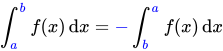
∫
a
b
f
(
x
)
d
x
=
−
∫
b
a
f
(
x
)
d
x
{\displaystyle \int _{\color {blue}a}^{\color {blue}b}f(x)\,\mathrm {d} x={\color {blue}-}\int _{\color {blue}b}^{\color {blue}a}f(x)\,\mathrm {d} x}
intégration par parties :
∫
f
(
x
)
g
′
(
x
)
d
x
=
[
f
(
x
)
g
(
x
)
]
−
∫
f
′
(
x
)
g
(
x
)
d
x
{\displaystyle \int {\color {Blue}f(x)}\,{\color {blue}g'(x)}\,\mathrm {d} x=[{\color {Blue}f(x)}\,{\color {Blue}g(x)}]-\int {\color {Blue}f'(x)}\,{\color {blue}g(x)}\,\mathrm {d} x}
mnémotechnique :
∫
u
v
′
=
[
u
v
]
−
∫
u
′
v
{\displaystyle \int {\color {Blue}u}{\color {blue}v'}=[{\color {Blue}u}{\color {Blue}v}]\ -\int {\color {Blue}u'}{\color {blue}v}}
avec
u
=
f
(
x
)
,
u
′
=
f
′
(
x
)
,
v
=
g
(
x
)
,
v
′
=
g
′
(
x
)
{\displaystyle u=f(x),~u'=f'(x),~v=g(x),~v'=g'(x)}
dx implicite.
intégration par changement de variable (si f et φ' sont continues) :
∫
a
b
f
(
φ
(
t
)
)
φ
′
(
t
)
d
t
=
∫
φ
(
a
)
φ
(
b
)
f
(
x
)
d
x
{\displaystyle \int _{a}^{b}f({\color {Blue}\varphi (t)})\,{\color {Blue}\varphi '(t)}\,\mathrm {d} {\color {Blue}t}=\int _{\color {blue}\varphi (a)}^{\color {blue}\varphi (b)}f({\color {Blue}x})\,\mathrm {d} {\color {Blue}x}}
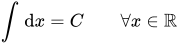
∫
d
x
=
C
∀
x
∈
R
{\displaystyle \int \,\mathrm {d} x=C\qquad \forall x\in \mathbb {R} }
∫
x
n
d
x
=
x
n
+
1
n
+
1
+
C
si
n
≠
−
1
{\displaystyle \int x^{n}\,\mathrm {d} x={\frac {x^{n+1}}{n+1}}+C\qquad {\text{ si }}n\neq -1}
∫
1
x
d
x
=
ln
|
x
|
+
C
si
x
≠
0
{\displaystyle \int {\frac {1}{x}}\,\mathrm {d} x=\ln \left|x\right|+C\qquad {\text{ si }}x\neq 0}
∫
1
x
−
a
d
x
=
ln
|
x
−
a
|
+
C
si
x
≠
a
{\displaystyle \int {\frac {1}{x-a}}\,\mathrm {d} x=\ln |x-a|+C\qquad {\text{ si }}x\neq a}
∫
1
(
x
−
a
)
n
d
x
=
−
1
(
n
−
1
)
(
x
−
a
)
n
−
1
+
C
si
n
≠
1
et
x
≠
a
{\displaystyle \int {\frac {1}{(x-a)^{n}}}\,\mathrm {d} x=-{\frac {1}{(n-1)(x-a)^{n-1}}}+C\qquad {\text{ si }}n\neq 1{\text{ et }}x\neq a}
∫
1
1
+
x
2
d
x
=
arctan
x
+
C
∀
x
∈
R
{\displaystyle \int {\frac {1}{1+x^{2}}}\,\mathrm {d} x=\operatorname {arctan} x+C\qquad \forall x\in \mathbb {R} }
∫
1
a
2
+
x
2
d
x
=
1
a
arctan
x
a
+
C
si
a
≠
0
{\displaystyle \int {\frac {1}{a^{2}+x^{2}}}\,\mathrm {d} x={\frac {1}{a}}\operatorname {arctan} {\frac {x}{a}}+C\qquad {\text{ si }}a\neq 0}
∫
1
1
−
x
2
d
x
=
1
2
ln
|
x
+
1
x
−
1
|
+
C
=
{
artanh
x
+
C
sur
]
−
1
,
1
[
arcoth
x
+
C
sur
]
−
∞
,
−
1
[
et sur
]
1
,
+
∞
[
.
{\displaystyle \int {\frac {1}{1-x^{2}}}\,\mathrm {d} x={\frac {1}{2}}\ln {\left|{\frac {x+1}{x-1}}\right|}+C={\begin{cases}\operatorname {artanh} x+C&{\text{ sur }}]-1,1[\\\operatorname {arcoth} x+C&{\text{ sur }}]-\infty ,-1[{\text{ et sur }}]1,+\infty [.\end{cases}}}
∀
x
∈
R
+
∗
{\displaystyle \forall x\in \mathbb {R} _{+}^{*}}
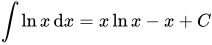
∫
ln
x
d
x
=
x
ln
x
−
x
+
C
{\displaystyle \int \ln x\,\mathrm {d} x=x\ln x-x+C}
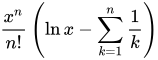
Plus généralement, une primitive n -ième de
ln
{\displaystyle \ln }
x
n
n
!
(
ln
x
−
∑
k
=
1
n
1
k
)
{\displaystyle {\frac {x^{n}}{n!}}\left(\ln x-\sum _{k=1}^{n}{\frac {1}{k}}\right)}
∀
x
∈
R
{\displaystyle \forall x\in \mathbb {R} }
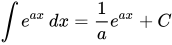
∫
e
a
x
d
x
=
1
a
e
a
x
+
C
{\displaystyle \int e^{ax}\,dx={\frac {1}{a}}e^{ax}+C}
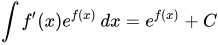
∫
f
′
(
x
)
e
f
(
x
)
d
x
=
e
f
(
x
)
+
C
{\displaystyle \int f'(x)e^{f(x)}\,dx=e^{f(x)}+C}
∫
a
x
d
x
=
a
x
ln
a
+
C
si
a
>
0
{\displaystyle \int a^{x}\,\mathrm {d} x={\frac {a^{x}}{\ln a}}+C\qquad {\text{ si }}a>0}
a ≠ 1ln(1) = 0 .
∀
x
∈
R
∖
{
−
1
,
1
}
{\displaystyle \forall x\in \mathbb {R} \setminus \{-1,1\}}
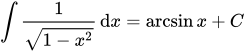
∫
1
1
−
x
2
d
x
=
arcsin
x
+
C
{\displaystyle \int {1 \over {\sqrt {1-x^{2}}}}\,\mathrm {d} x=\operatorname {arcsin} x+C}
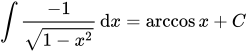
∫
−
1
1
−
x
2
d
x
=
arccos
x
+
C
{\displaystyle \int {-1 \over {\sqrt {1-x^{2}}}}\,\mathrm {d} x=\operatorname {arccos} x+C}
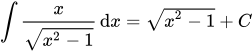
∫
x
x
2
−
1
d
x
=
x
2
−
1
+
C
{\displaystyle \int {x \over {\sqrt {x^{2}-1}}}\,\mathrm {d} x={\sqrt {x^{2}-1}}+C}
Calculateur automatique de primitive par Mathematica




![{\displaystyle \int {\color {Blue}f(x)}\,{\color {blue}g'(x)}\,\mathrm {d} x=[{\color {Blue}f(x)}\,{\color {Blue}g(x)}]-\int {\color {Blue}f'(x)}\,{\color {blue}g(x)}\,\mathrm {d} x}](https://wikimedia.org/api/rest_v1/media/math/render/svg/7bc9519bfb0e03e5ae2d4961698706900bf585b9)
![{\displaystyle \int {\color {Blue}u}{\color {blue}v'}=[{\color {Blue}u}{\color {Blue}v}]\ -\int {\color {Blue}u'}{\color {blue}v}}](https://wikimedia.org/api/rest_v1/media/math/render/svg/00345b12d5657340858992488c3ecde9921582cf)








![{\displaystyle \int {\frac {1}{1-x^{2}}}\,\mathrm {d} x={\frac {1}{2}}\ln {\left|{\frac {x+1}{x-1}}\right|}+C={\begin{cases}\operatorname {artanh} x+C&{\text{ sur }}]-1,1[\\\operatorname {arcoth} x+C&{\text{ sur }}]-\infty ,-1[{\text{ et sur }}]1,+\infty [.\end{cases}}}](https://wikimedia.org/api/rest_v1/media/math/render/svg/57a051e315447e6d6e38ad1b3cd5e78237143c3b)