Technopedia Center
PMB University Brochure
Faculty of Engineering and Computer Science
S1 Informatics S1 Information Systems S1 Information Technology S1 Computer Engineering S1 Electrical Engineering S1 Civil Engineering

faculty of Economics and Business
S1 Management S1 Accountancy

Faculty of Letters and Educational Sciences
S1 English literature S1 English language education S1 Mathematics education S1 Sports Education
  • Registerasi
  • Brosur UTI
  • Kip Scholarship Information
  • Performance
  1. Weltenzyklopädie
  2. Entier profini — Wikipédia
Entier profini — Wikipédia 👆 Click Here! Read More..
Un article de Wikipédia, l'encyclopédie libre.

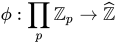
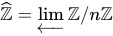
En mathématiques, un entier profini est un élément de l'anneau Z ^ = lim ← ⁡ Z / n Z {\displaystyle {\widehat {\mathbb {Z} }}=\varprojlim \mathbb {Z} /n\mathbb {Z} } {\displaystyle {\widehat {\mathbb {Z} }}=\varprojlim \mathbb {Z} /n\mathbb {Z} } (parfois prononcé Z chapeau), limite projective des anneaux quotient Z / n Z {\displaystyle \mathbb {Z} /n\mathbb {Z} } {\displaystyle \mathbb {Z} /n\mathbb {Z} }, où les entiers n {\displaystyle n} {\displaystyle n} sont partiellement ordonnés par la relation de divisibilité. Cet anneau est donc, par définition, la complétion profinie de l'anneau Z {\displaystyle \mathbb {Z} } {\displaystyle \mathbb {Z} } des entiers relatifs. D'après le théorème des restes chinois, Z ^ {\displaystyle {\widehat {\mathbb {Z} }}} {\displaystyle {\widehat {\mathbb {Z} }}} peut aussi être vu comme un produit d'anneaux : Z ^ = ∏ p Z p , {\displaystyle {\widehat {\mathbb {Z} }}=\prod _{p}\mathbb {Z} _{p},} {\displaystyle {\widehat {\mathbb {Z} }}=\prod _{p}\mathbb {Z} _{p},} où l'indice p {\displaystyle p} {\displaystyle p} parcourt les nombres premiers, et où Z p {\displaystyle \mathbb {Z} _{p}} {\displaystyle \mathbb {Z} _{p}} est l'anneau des entiers p {\displaystyle p} {\displaystyle p}-adiques. Cet anneau a d'importantes relations avec la théorie de Galois et l'anneau des adèles. C'est aussi un exemple caractéristique de groupe profini.
Construction

[modifier | modifier le code]

Z ^ {\displaystyle {\widehat {\mathbb {Z} }}} {\displaystyle {\widehat {\mathbb {Z} }}}, l'ensemble des entiers profinis, peut être construit comme l'ensemble des suites de restes de la forme υ = ( υ 1 mod 1 ,   υ 2 mod 2 ,   υ 3 mod 3 ,   … ) {\displaystyle \upsilon =(\upsilon _{1}{\bmod {1}},~\upsilon _{2}{\bmod {2}},~\upsilon _{3}{\bmod {3}},~\ldots )} {\displaystyle \upsilon =(\upsilon _{1}{\bmod {1}},~\upsilon _{2}{\bmod {2}},~\upsilon _{3}{\bmod {3}},~\ldots )} tels que m   |   n ⟹ υ m ≡ υ n mod m {\displaystyle m\ |\ n\implies \upsilon _{m}\equiv \upsilon _{n}{\bmod {m}}} {\displaystyle m\ |\ n\implies \upsilon _{m}\equiv \upsilon _{n}{\bmod {m}}}.

L'addition et la multiplication terme à terme de ces suites font de Z ^ {\displaystyle {\widehat {\mathbb {Z} }}} {\displaystyle {\widehat {\mathbb {Z} }}} un anneau commutatif, dans lequel l'anneau des entiers Z {\displaystyle {\mathbb {Z} }} {\displaystyle {\mathbb {Z} }} est plongé par l'injection canonique i : {\displaystyle i:} {\displaystyle i:} m ↦ ( m mod 1 ,   m mod 2 ,   m mod 3 ,   … ) {\displaystyle m\mapsto (m{\bmod {1}},~m{\bmod {2}},~m{\bmod {3}},~\ldots )} {\displaystyle m\mapsto (m{\bmod {1}},~m{\bmod {2}},~m{\bmod {3}},~\ldots )}. i {\displaystyle i} {\displaystyle i} est canonique car elle satisfait une propriété universelle pour les groupes profinis : pour tout groupe profini H {\displaystyle H} {\displaystyle H} et tout morphisme de groupes f : Z → H {\displaystyle f:\mathbb {Z} \rightarrow H} {\displaystyle f:\mathbb {Z} \rightarrow H}, il existe un unique morphisme de groupe continu g : Z ^ → H {\displaystyle g:{\widehat {\mathbb {Z} }}\rightarrow H} {\displaystyle g:{\widehat {\mathbb {Z} }}\rightarrow H} tel que f = g ∘ i {\displaystyle f=g\circ i} {\displaystyle f=g\circ i}.

Avec la représentation factorielle des entiers

[modifier | modifier le code]

Tout entier n ≥ 0 {\displaystyle n\geq 0} {\displaystyle n\geq 0} a une représentation unique en numération factorielle (en) de la forme n = ∑ i = 1 ∞ c i i ! avec  c i ∈ Z {\displaystyle n=\sum _{i=1}^{\infty }c_{i}i!\qquad {\text{avec }}c_{i}\in \mathbb {Z} } {\displaystyle n=\sum _{i=1}^{\infty }c_{i}i!\qquad {\text{avec }}c_{i}\in \mathbb {Z} } où 0 ≤ c i ≤ i {\displaystyle 0\leq c_{i}\leq i} {\displaystyle 0\leq c_{i}\leq i} pour tout i {\displaystyle i} {\displaystyle i}, et où seuls un nombre fini des c 1 , c 2 , c 3 , … {\displaystyle c_{1},c_{2},c_{3},\ldots } {\displaystyle c_{1},c_{2},c_{3},\ldots } sont non nuls ; cette représentation s'écrit parfois n = ( ⋯ c 3 c 2 c 1 ) ! {\displaystyle n=(\cdots c_{3}c_{2}c_{1})_{!}} {\displaystyle n=(\cdots c_{3}c_{2}c_{1})_{!}}.

Les entiers profinis correspondent alors à des sommes formelles n = ∑ i = 1 ∞ c i i ! = ( ⋯ c 3 c 2 c 1 ) ! {\displaystyle n=\sum _{i=1}^{\infty }c_{i}i!=(\cdots c_{3}c_{2}c_{1})_{!}} {\displaystyle n=\sum _{i=1}^{\infty }c_{i}i!=(\cdots c_{3}c_{2}c_{1})_{!}} sans aucune restriction sur les c i {\displaystyle c_{i}} {\displaystyle c_{i}} autre que 0 ≤ c i ≤ i {\displaystyle 0\leq c_{i}\leq i} {\displaystyle 0\leq c_{i}\leq i}[1].

Les "chiffres" c 1 , c 2 , c 3 , … , c k − 1 {\displaystyle c_{1},c_{2},c_{3},\ldots ,c_{k-1}} {\displaystyle c_{1},c_{2},c_{3},\ldots ,c_{k-1}} déterminent la valeur de l'entier profini mod k ! {\displaystyle k!} {\displaystyle k!}. Plus précisément, il y a un morphisme d'anneaux Z ^ → Z / k ! Z {\displaystyle {\widehat {\mathbb {Z} }}\to \mathbb {Z} /k!\,\mathbb {Z} } {\displaystyle {\widehat {\mathbb {Z} }}\to \mathbb {Z} /k!\,\mathbb {Z} } envoyant ( ⋯ c 3 c 2 c 1 ) !    vers    ∑ i = 1 k − 1 c i i ! mod k ! {\displaystyle (\cdots c_{3}c_{2}c_{1})_{!}\ {\text{ vers }}\ \sum _{i=1}^{k-1}c_{i}i!\mod k!} {\displaystyle (\cdots c_{3}c_{2}c_{1})_{!}\ {\text{ vers }}\ \sum _{i=1}^{k-1}c_{i}i!\mod k!} ; Z ^ {\displaystyle {\widehat {\mathbb {Z} }}} {\displaystyle {\widehat {\mathbb {Z} }}} est donc la limite projective du système des anneaux Z ^ → Z / k ! Z {\displaystyle {\widehat {\mathbb {Z} }}\to \mathbb {Z} /k!\,\mathbb {Z} } {\displaystyle {\widehat {\mathbb {Z} }}\to \mathbb {Z} /k!\,\mathbb {Z} }.

Avec le théorème des restes chinois

[modifier | modifier le code]

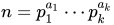
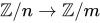
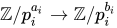
Une autre façon de construire Z ^ {\displaystyle {\widehat {\mathbb {Z} }}} {\displaystyle {\widehat {\mathbb {Z} }}} est d'utiliser le théorème des restes chinois. On sait que pour tout entier n {\displaystyle n} {\displaystyle n} dont la factorisation en nombres premiers est n = p 1 a 1 ⋯ p k a k {\displaystyle n=p_{1}^{a_{1}}\cdots p_{k}^{a_{k}}} {\displaystyle n=p_{1}^{a_{1}}\cdots p_{k}^{a_{k}}}, ce théorème permet de construire un isomorphisme d'anneaux Z / n ≅ Z / p 1 a 1 × ⋯ × Z / p k a k {\displaystyle \mathbb {Z} /n\cong \mathbb {Z} /p_{1}^{a_{1}}\times \cdots \times \mathbb {Z} /p_{k}^{a_{k}}} {\displaystyle \mathbb {Z} /n\cong \mathbb {Z} /p_{1}^{a_{1}}\times \cdots \times \mathbb {Z} /p_{k}^{a_{k}}}. De plus, toute surjection Z / n → Z / m {\displaystyle \mathbb {Z} /n\to \mathbb {Z} /m} {\displaystyle \mathbb {Z} /n\to \mathbb {Z} /m} induit des surjections Z / p i a i → Z / p i b i {\displaystyle \mathbb {Z} /p_{i}^{a_{i}}\to \mathbb {Z} /p_{i}^{b_{i}}} {\displaystyle \mathbb {Z} /p_{i}^{a_{i}}\to \mathbb {Z} /p_{i}^{b_{i}}} sur chacun des facteurs de m {\displaystyle m} {\displaystyle m} et n {\displaystyle n} {\displaystyle n}, puisqu'on doit avoir a i ≥ b i {\displaystyle a_{i}\geq b_{i}} {\displaystyle a_{i}\geq b_{i}}; on en déduit un isomorphisme de Z ^ {\displaystyle {\widehat {\mathbb {Z} }}} {\displaystyle {\widehat {\mathbb {Z} }}} avec le produit direct des anneaux des entiers p {\displaystyle p} {\displaystyle p}-adiques ∏ p Z p {\displaystyle \prod _{p}\mathbb {Z} _{p}} {\displaystyle \prod _{p}\mathbb {Z} _{p}} défini par ϕ : ∏ p Z p → Z ^ {\displaystyle \phi :\prod _{p}\mathbb {Z} _{p}\to {\widehat {\mathbb {Z} }}} {\displaystyle \phi :\prod _{p}\mathbb {Z} _{p}\to {\widehat {\mathbb {Z} }}} tel que ϕ ( ( n 2 , n 3 , n 5 , ⋯ ) ) ( k ) = ∏ q n q mod k {\displaystyle \phi ((n_{2},n_{3},n_{5},\cdots ))(k)=\prod _{q}n_{q}\mod k} {\displaystyle \phi ((n_{2},n_{3},n_{5},\cdots ))(k)=\prod _{q}n_{q}\mod k}, où q {\displaystyle q} {\displaystyle q} parcourt les facteurs de k {\displaystyle k} {\displaystyle k} de la forme p i d i {\displaystyle p_{i}^{d_{i}}} {\displaystyle p_{i}^{d_{i}}}, autrement dit k = ∏ i = 1 l p i d i {\displaystyle k=\prod _{i=1}^{l}p_{i}^{d_{i}}} {\displaystyle k=\prod _{i=1}^{l}p_{i}^{d_{i}}} pour une suite de nombre premiers distincts p 1 , . . . , p l {\displaystyle p_{1},...,p_{l}} {\displaystyle p_{1},...,p_{l}}.

Relations

[modifier | modifier le code]

Propriétés topologiques

[modifier | modifier le code]

L'ensemble des entiers profinis peut être vu comme un sous-ensemble fermé du produit direct infini ∏ n = 1 ∞ Z / n Z {\displaystyle \prod _{n=1}^{\infty }\mathbb {Z} /n\mathbb {Z} } {\displaystyle \prod _{n=1}^{\infty }\mathbb {Z} /n\mathbb {Z} } muni de la topologie produit des topologies discrètes sur chacun des Z / n Z {\displaystyle \mathbb {Z} /n\mathbb {Z} } {\displaystyle \mathbb {Z} /n\mathbb {Z} }. Ce produit (et par conséquent Z ^ {\displaystyle {\widehat {\mathbb {Z} }}} {\displaystyle {\widehat {\mathbb {Z} }}} également) est un espace séparé compact d'après le théorème de Tychonov.

Cette topologie sur Z ^ {\displaystyle {\widehat {\mathbb {Z} }}} {\displaystyle {\widehat {\mathbb {Z} }}} peut être définie directement par la distance d ( x , y ) = 1 min { k ∈ Z > 0 : x ≢ y mod ( k + 1 ) ! } {\displaystyle d(x,y)={\frac {1}{\min\{k\in \mathbb {Z} _{>0}:x\not \equiv y{\bmod {(k+1)!}}\}}}} {\displaystyle d(x,y)={\frac {1}{\min\{k\in \mathbb {Z} _{>0}:x\not \equiv y{\bmod {(k+1)!}}\}}}}[1]

L'addition sur Z ^ {\displaystyle {\widehat {\mathbb {Z} }}} {\displaystyle {\widehat {\mathbb {Z} }}} étant continue, Z ^ {\displaystyle {\widehat {\mathbb {Z} }}} {\displaystyle {\widehat {\mathbb {Z} }}} est un groupe abélien compact et donc son dual de Pontriaguine doit être un groupe abélien discret ; effectivement ce dual est le groupe Q / Z {\displaystyle \mathbb {Q} /\mathbb {Z} } {\displaystyle \mathbb {Q} /\mathbb {Z} } muni de la topologie discrète.

Il est explicitement construit par la fonction Q / Z × Z ^ → U ( 1 ) , ( q , a ) ↦ χ ( q a ) {\displaystyle \mathbb {Q} /\mathbb {Z} \times {\widehat {\mathbb {Z} }}\to U(1),\,(q,a)\mapsto \chi (qa)} {\displaystyle \mathbb {Q} /\mathbb {Z} \times {\widehat {\mathbb {Z} }}\to U(1),\,(q,a)\mapsto \chi (qa)}[2], où χ {\displaystyle \chi } {\displaystyle \chi } est le caractère de l'adèle A Q , f {\displaystyle \mathbf {A} _{\mathbb {Q} ,f}} {\displaystyle \mathbf {A} _{\mathbb {Q} ,f}} induit par Q / Z → U ( 1 ) , α ↦ e 2 π i α {\displaystyle \mathbb {Q} /\mathbb {Z} \to U(1),\,\alpha \mapsto e^{2\pi i\alpha }} {\displaystyle \mathbb {Q} /\mathbb {Z} \to U(1),\,\alpha \mapsto e^{2\pi i\alpha }}(voir ci-dessous)[3].

Relation aux adèles

[modifier | modifier le code]

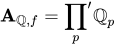
Le produit tensoriel Z ^ ⊗ Z Q {\displaystyle {\widehat {\mathbb {Z} }}\otimes _{\mathbb {Z} }\mathbb {Q} } {\displaystyle {\widehat {\mathbb {Z} }}\otimes _{\mathbb {Z} }\mathbb {Q} } est l'anneau des adèles finies de Q {\displaystyle \mathbb {Q} } {\displaystyle \mathbb {Q} }, A Q , f = ∏ p ′ Q p {\displaystyle \mathbf {A} _{\mathbb {Q} ,f}={\prod _{p}}'\mathbb {Q} _{p}} {\displaystyle \mathbf {A} _{\mathbb {Q} ,f}={\prod _{p}}'\mathbb {Q} _{p}}, où le symbole ′ {\displaystyle '} {\displaystyle '} veut dire produit restreint, c'est-à-dire qu'on ne prend que les suites entières sauf en un nombre fini de places[4]. Il y a un isomorphisme entre l'anneau des adèles et le produit de l'anneau des adèles finies par R {\displaystyle \mathbb {R} } {\displaystyle \mathbb {R} } : A Q ≅ R × ( Z ^ ⊗ Z Q ) {\displaystyle \mathbf {A} _{\mathbb {Q} }\cong \mathbb {R} \times ({\hat {\mathbb {Z} }}\otimes _{\mathbb {Z} }\mathbb {Q} )} {\displaystyle \mathbf {A} _{\mathbb {Q} }\cong \mathbb {R} \times ({\hat {\mathbb {Z} }}\otimes _{\mathbb {Z} }\mathbb {Q} )}.

Applications

[modifier | modifier le code]

Groupe de Galois absolu des corps finis

[modifier | modifier le code]

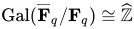
Le groupe de Galois de la clôture algébrique F ¯ q {\displaystyle {\overline {\mathbf {F} }}_{q}} {\displaystyle {\overline {\mathbf {F} }}_{q}} du corps fini F q {\displaystyle \mathbf {F} _{q}} {\displaystyle \mathbf {F} _{q}} d'ordre q (puissance d'un nombre premier) peut être calculé explicitement : comme Gal ( F q n / F q ) ≅ Z / n Z {\displaystyle {\text{Gal}}(\mathbf {F} _{q^{n}}/\mathbf {F} _{q})\cong \mathbb {Z} /n\mathbb {Z} } {\displaystyle {\text{Gal}}(\mathbf {F} _{q^{n}}/\mathbf {F} _{q})\cong \mathbb {Z} /n\mathbb {Z} } (les automorphismes étant les puissances de l'automorphisme de Frobenius), le groupe de Galois de la clôture algébrique de F q {\displaystyle \mathbf {F} _{q}} {\displaystyle \mathbf {F} _{q}} est la limite projective des Z / n Z {\displaystyle \mathbb {Z} /n\mathbb {Z} } {\displaystyle \mathbb {Z} /n\mathbb {Z} }, et donc isomorphe au groupe des entiers profinis[5] : Gal ⁡ ( F ¯ q / F q ) ≅ Z ^ {\displaystyle \operatorname {Gal} ({\overline {\mathbf {F} }}_{q}/\mathbf {F} _{q})\cong {\widehat {\mathbb {Z} }}} {\displaystyle \operatorname {Gal} ({\overline {\mathbf {F} }}_{q}/\mathbf {F} _{q})\cong {\widehat {\mathbb {Z} }}} ; ceci donne donc une détermination explicite du groupe de Galois absolu des corps finis.

Relation au groupe fondamental étale des tores algébriques

[modifier | modifier le code]

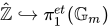
Une interprétation de ces constructions vient de la théorie de l'homotopie étale (en), qui définit le groupe fondamental étale (en) π 1 e t ( X ) {\displaystyle \pi _{1}^{et}(X)} {\displaystyle \pi _{1}^{et}(X)} comme une complétion profinie d'automorphismes : π 1 e t ( X ) = lim i ∈ I Aut ( X i / X ) {\displaystyle \pi _{1}^{et}(X)=\lim _{i\in I}{\text{Aut}}(X_{i}/X)} {\displaystyle \pi _{1}^{et}(X)=\lim _{i\in I}{\text{Aut}}(X_{i}/X)} où les X i → X {\displaystyle X_{i}\to X} {\displaystyle X_{i}\to X} forment un recouvrement étale (en).Le calcul précédent montre alors que les entiers profinis sont isomorphes au groupe π 1 e t ( Spec ( F q ) ) ≅ Z ^ {\displaystyle \pi _{1}^{et}({\text{Spec}}(\mathbf {F} _{q}))\cong {\hat {\mathbb {Z} }}} {\displaystyle \pi _{1}^{et}({\text{Spec}}(\mathbf {F} _{q}))\cong {\hat {\mathbb {Z} }}}. De plus, il y a un plongement des entiers profinis dans le groupe fondamental étale du tore algébrique Z ^ ↪ π 1 e t ( G m ) {\displaystyle {\hat {\mathbb {Z} }}\hookrightarrow \pi _{1}^{et}(\mathbb {G} _{m})} {\displaystyle {\hat {\mathbb {Z} }}\hookrightarrow \pi _{1}^{et}(\mathbb {G} _{m})}, puisque G m = Spec ( Z [ x , x − 1 ] ) {\displaystyle \mathbb {G} _{m}={\text{Spec}}(\mathbb {Z} [x,x^{-1}])} {\displaystyle \mathbb {G} _{m}={\text{Spec}}(\mathbb {Z} [x,x^{-1}])}.

Les entiers profinis et la théorie des corps de classes

[modifier | modifier le code]

La théorie des corps de classes est une branche de la théorie algébrique des nombres qui étudie les extensions abéliennes des corps. Partant du corps global Q {\displaystyle \mathbb {Q} } {\displaystyle \mathbb {Q} }, l'abélianisé de son groupe de Galois absolu Gal ( Q ¯ / Q ) a b {\displaystyle {\text{Gal}}({\overline {\mathbb {Q} }}/\mathbb {Q} )^{ab}} {\displaystyle {\text{Gal}}({\overline {\mathbb {Q} }}/\mathbb {Q} )^{ab}} est étroitement relié à l'anneau adélique associé A Q {\displaystyle \mathbb {A} _{\mathbb {Q} }} {\displaystyle \mathbb {A} _{\mathbb {Q} }} et au groupe des entiers profinis. En particulier, il y a une application, due à Artin[6], Ψ Q : A Q × / Q × → Gal ( Q ¯ / Q ) a b {\displaystyle \Psi _{\mathbb {Q} }:\mathbb {A} _{\mathbb {Q} }^{\times }/\mathbb {Q} ^{\times }\to {\text{Gal}}({\overline {\mathbb {Q} }}/\mathbb {Q} )^{ab}} {\displaystyle \Psi _{\mathbb {Q} }:\mathbb {A} _{\mathbb {Q} }^{\times }/\mathbb {Q} ^{\times }\to {\text{Gal}}({\overline {\mathbb {Q} }}/\mathbb {Q} )^{ab}}, qui est un isomorphisme. Ce quotient peut de plus être déterminé explicitement : A Q × / Q × ≅ ( R × Z ^ ) / Z = lim ← ( R / m Z ) = lim x ↦ x m S 1 = Z ^ {\displaystyle \mathbb {A} _{\mathbb {Q} }^{\times }/\mathbb {Q} ^{\times }\cong (\mathbb {R} \times {\hat {\mathbb {Z} }})/\mathbb {Z} ={\underset {\leftarrow }{\lim }}\mathbb {(} {\mathbb {R} }/m\mathbb {Z} )={\underset {x\mapsto x^{m}}{\lim }}S^{1}={\hat {\mathbb {Z} }}} {\displaystyle \mathbb {A} _{\mathbb {Q} }^{\times }/\mathbb {Q} ^{\times }\cong (\mathbb {R} \times {\hat {\mathbb {Z} }})/\mathbb {Z} ={\underset {\leftarrow }{\lim }}\mathbb {(} {\mathbb {R} }/m\mathbb {Z} )={\underset {x\mapsto x^{m}}{\lim }}S^{1}={\hat {\mathbb {Z} }}}, ce qui donne la relation annoncée. Un résultat analogue existe pour la théorie du corps de classes local, puisque chaque extension abélienne finie de K / Q p {\displaystyle K/\mathbb {Q} _{p}} {\displaystyle K/\mathbb {Q} _{p}} est induite par une extension de corps F p n / F p {\displaystyle \mathbb {F} _{p^{n}}/\mathbb {F} _{p}} {\displaystyle \mathbb {F} _{p^{n}}/\mathbb {F} _{p}}.

Voir aussi

[modifier | modifier le code]
  • Anneau adélique
  • Entier surnaturel

Notes

[modifier | modifier le code]
  1. ↑ a et b (en) Hendrik Lenstra, « Profinite number theory », sur Mathematical Association of America (consulté le 11 août 2022)
  2. ↑ Connes et Consani 2015, § 2.4.
  3. ↑ K. Conrad, The character group of Q
  4. ↑ Questions on some maps involving rings of finite adeles and their unit groups.
  5. ↑ Milne 2013, Ch. I Example A. 5.
  6. ↑ « Class field theory - lccs », sur www.math.columbia.edu (consulté le 25 septembre 2020)

Références

[modifier | modifier le code]
  • (en) Cet article est partiellement ou en totalité issu de l’article de Wikipédia en anglais intitulé « Profinite integer » (voir la liste des auteurs).
  • (en) Alain Connes et Caterina Consani, « Geometry of the arithmetic site », 2015.
  • (en) James Milne, « Class Field Theory » [archive du 19 juin 2013], 23 mars 2013 (consulté le 7 juin 2020)

Liens externes

[modifier | modifier le code]
  • (en) La complétion profinie des entiers, sur le site de ncatlab.org
v · m
Notion de nombre
Ensembles usuels
  • Entier naturel ( N {\displaystyle \scriptstyle \mathbb {N} } {\displaystyle \scriptstyle \mathbb {N} })
  • Entier relatif ( Z {\displaystyle \scriptstyle \mathbb {Z} } {\displaystyle \scriptstyle \mathbb {Z} })
  • Nombre décimal ( D {\displaystyle \scriptstyle \mathbb {D} } {\displaystyle \scriptstyle \mathbb {D} })
  • Nombre rationnel ( Q {\displaystyle \scriptstyle \mathbb {Q} } {\displaystyle \scriptstyle \mathbb {Q} })
  • Nombre réel ( R {\displaystyle \scriptstyle \mathbb {R} } {\displaystyle \scriptstyle \mathbb {R} })
  • Nombre complexe ( C {\displaystyle \scriptstyle \mathbb {C} } {\displaystyle \scriptstyle \mathbb {C} })
Mathématiques
Extensions
  • Quaternion ( H {\displaystyle \scriptstyle \mathbb {H} } {\displaystyle \scriptstyle \mathbb {H} })
  • Octonion ( O {\displaystyle \scriptstyle \mathbb {O} } {\displaystyle \scriptstyle \mathbb {O} })
  • Sédénion ( S {\displaystyle \scriptstyle \mathbb {S} } {\displaystyle \scriptstyle \mathbb {S} })
  • Nombre complexe déployé
  • Tessarine
  • Nombre bicomplexe ( C 2 {\displaystyle \scriptstyle \mathbb {C} _{2}} {\displaystyle \scriptstyle \mathbb {C} _{2}})
  • Nombre multicomplexe ( C n {\displaystyle \scriptstyle \mathbb {C} _{n}} {\displaystyle \scriptstyle \mathbb {C} _{n}}
  • M C n {\displaystyle \scriptstyle {\mathcal {M}}\mathbb {C} _{n}} {\displaystyle \scriptstyle {\mathcal {M}}\mathbb {C} _{n}})
  • Biquaternion
  • Coquaternion
  • Quaternion hyperbolique
  • Octonion déployé
  • Nombre hypercomplexe
  • Nombre p-adique ( Q p {\displaystyle \scriptstyle \mathbb {Q} _{p}} {\displaystyle \scriptstyle \mathbb {Q} _{p}})
  • Nombre hyperréel
  • Nombre superréel
  • Entier surnaturel
  • Entier profini
  • Nombre dual
  • Droite réelle achevée
  • Nombre cardinal
  • Nombre ordinal
  • Nombre surréel
  • Nombre pseudo-réel
Propriétés particulières
  • Parité
  • Nombre premier
  • Nombre composé
  • Nombre figuré
  • Nombre parfait
  • Nombre positif
  • Nombre négatif
  • Fraction dyadique
  • Bon article Nombre irrationnel
  • Nombre algébrique
  • Nombre transcendant
  • Nombre imaginaire pur
  • Nombre de Liouville
  • Période
  • Nombre normal
  • Nombre univers
  • Nombre constructible
  • Nombre réel calculable
  • Nombre transfini
  • Infiniment petit
Exemples
  • Pi (π)
  • Racine carrée de deux ( 2 {\displaystyle \scriptstyle {\sqrt {2}}} {\displaystyle \scriptstyle {\sqrt {2}}})
  • Bon article Nombre d’or (φ)
  • Zéro (0)
  • Unité imaginaire (i)
  • Constante d’Euler (e)
  • Aleph-zéro (ℵ0)
  • Table de constantes mathématiques
Articles liés
  • Chiffre
  • Numération
  • Fraction
  • Opération
  • Calcul
  • Algèbre
  • Arithmétique
  • Suite d'entiers
  • Infini (∞)
  • Chiffre significatif
  • icône décorative Arithmétique et théorie des nombres
Ce document provient de « https://fr.teknopedia.teknokrat.ac.id/w/index.php?title=Entier_profini&oldid=229034503 ».
Catégories :
  • Théorie algébrique des nombres
  • Type de nombre
  • Théorie des anneaux
Catégories cachées :
  • Article contenant un appel à traduction en anglais
  • Portail:Arithmétique et théorie des nombres/Articles liés
  • Portail:Sciences/Articles liés
  • Portail:Mathématiques/Articles liés

  • indonesia
  • Polski
  • الرية
  • Deutsch
  • English
  • Español
  • Français
  • Italiano
  • مصر
  • Nederlands
  • 本語
  • Português
  • Sinugboanong Binisaya
  • Svenska
  • Українска
  • Tiếng Việt
  • Winaray
  • 中文
  • Русски
Sunting pranala
Pusat Layanan

UNIVERSITAS TEKNOKRAT INDONESIA | ASEAN's Best Private University
Jl. ZA. Pagar Alam No.9 -11, Labuhan Ratu, Kec. Kedaton, Kota Bandar Lampung, Lampung 35132
Phone: (0721) 702022
Email: pmb@teknokrat.ac.id